




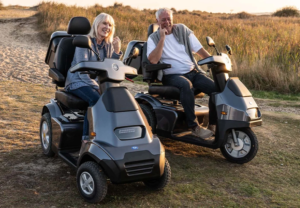
Buying a used mobility scooter can be an excellent way to regain independence while spending less than you would on a brand-new model.
A well-maintained second-hand scooter may offer years of reliable use, but condition varies. Weak batteries, worn tyres, hidden electrical faults or unsuitable dimensions can turn a cheap purchase into an expensive mistake. The scooter must be mechanically sound, comfortable to use and appropriate for your home, vehicle and regular journeys.
This guide explains what to inspect, what questions to ask and which warning signs to take seriously when buying privately or from a mobility retailer. You can also view Modern Mobility’s current selection of Approved Used mobility scooters, all of which are serviced and checked before sale.
Used Mobility Scooter Buyer’s Guide
Quick Answer
Before buying a used mobility scooter, check the battery condition, charger, tyres, brakes, steering, controls, lights, frame and any folding or dismantling mechanisms.
You should also confirm:
- The scooter’s maximum user weight
- Its dimensions and total weight
- Whether it is a Class 2 or Class 3 scooter
- Its estimated travelling range
- Whether it will fit your home or vehicle
- What warranty, servicing and after-sales support are included
Whenever possible, take a test drive and choose a scooter that has been inspected and serviced before sale.
Used Mobility Scooter Inspection Checklist
| What to check | What good looks like | Warning signs |
|---|---|---|
| Scooter type and size | Suitable for your routes, storage, transport needs and expected distances | Too large, too heavy, insufficient range or unsuitable for local terrain |
| Battery | Professionally tested, charges fully and holds power under load | Gauge drops quickly, weak performance or unknown battery age |
| Charger | Correct charger supplied with an undamaged cable and secure connection | Missing, incompatible, damaged or overheating charger |
| Tyres and wheels | Even tread, no cracks, correct pressure and no excessive wheel movement | Perishing, flat spots, bulges, grinding or uneven wear |
| Brakes and steering | Smooth acceleration, controlled stopping and straight tracking | Delayed braking, pulling to one side, stiffness or unusual noises |
| Lights and electrics | Lights, indicators, horn, controls and display work consistently | Flickering display, warning lights or intermittent switches |
| Frame and body | Structurally sound with only reasonable cosmetic wear | Cracks, bent metal, corrosion, water damage or repaired wiring |
| Seat and controls | Comfortable, adjustable and easy to operate | Loose seat, poor support, difficult controls or inadequate legroom |
| Folding or dismantling | Mechanisms work smoothly and the scooter fits the intended vehicle | Stiff catches, damaged joints or sections that are too heavy to lift |
| History and warranty | Clear service information, inspection records and written warranty terms | Unexplained faults, uncertain history or vague warranty promises |
| Accessories | Correct keys, batteries, charger and advertised accessories are included | Missing keys, mirrors, basket, canopy or essential components |
| Test drive | Smooth, quiet and comfortable on representative safe surfaces | Sudden power loss, instability, grinding or lack of control |
This checklist is a useful starting point, but it is not a substitute for a professional inspection. A scooter can pass a basic visual check while still having weak batteries, hidden electrical faults or suitability problems that only become apparent during a proper demonstration.
1. Make Sure It Is the Right Type of Mobility Scooter
A used scooter can be in excellent condition and still be the wrong purchase.
Before checking the battery or tyres, think about where and how the scooter will actually be used.
Ask yourself:
- Will it mainly be used on pavements, roads or both?
- How far will a typical journey be?
- Are your local routes flat, steep or uneven?
- Does it need to fit inside a car?
- Will anybody need to lift or dismantle it?
- Where will it be stored and charged?
Smaller Class 2 scooters are generally designed for pavement use and have a maximum speed of 4mph. If portability is important, Modern Mobility’s used car boot mobility scooters include models designed to fold or dismantle for transport.
Larger used scooters may offer greater range, suspension and road-going capability, but they are generally heavier and require more storage space.
You should also confirm that you have dry, secure storage and access to a suitable mains socket. Damp storage, prolonged outdoor exposure and long periods without charging can contribute to battery, electrical and corrosion problems.
Do not choose purely by price, colour or appearance. The scooter must be suitable for how and where you intend to use it.
2. Check the Battery, Charger and Expected Range
The battery is one of the most important and potentially expensive parts of a used mobility scooter.
A scooter may switch on and display a full charge while still having batteries that lose power rapidly once placed under load.
Ask the seller:
- How old are the batteries?
- Were they regularly charged while the scooter was not in use?
- Have they been professionally tested?
- How far does the scooter currently travel on a full charge?
- Are the batteries covered by any warranty?
A short drive around a driveway or showroom is not enough to confirm that the scooter will achieve the manufacturer’s original maximum range.
During a test drive, watch for a battery gauge that falls unusually quickly. Reduced speed on hills or sudden power loss may indicate weak batteries, although performance can also be affected by user weight, gradients, tyre pressure and temperature.
Where possible, ask for evidence that the batteries have been load-tested rather than simply checked to see whether they accept a charge.
Do not choose a scooter whose quoted maximum range only just covers your intended journey. Manufacturer ranges are measured under controlled conditions and can reduce with hills, cold weather, user weight, battery age and tyre pressure.
You should also confirm that:
- The correct charger is included
- It is suitable for the battery type fitted
- The plug and cable are undamaged
- The charging connection fits securely
- Indicator lights work correctly
- The battery reaches a full charge
Lithium batteries often require a specific charger, so do not assume that a generic mobility scooter charger will be suitable. Check the charging socket for looseness, corrosion, heat damage or cracked plastic.
3. Inspect the Tyres and Wheels
Mobility scooter tyres affect grip, comfort, steering, braking and range.
Check every tyre for:
- Cracks or perishing
- Low tread
- Uneven wear
- Flat spots
- Cuts or bulges
- Damage to solid tyres
- Low pressure in pneumatic tyres
If the scooter has pneumatic tyres, confirm that they hold pressure and ask whether any slow punctures or recurring tyre problems are known. Pneumatic tyres may provide a softer ride but require pressure checks and can puncture, while solid tyres avoid punctures but may feel firmer over uneven surfaces.
Check the wheels and rims for visible damage. There should not be excessive sideways movement, looseness or grinding when the wheels rotate.
Uneven tyre wear may sometimes suggest an alignment, suspension or steering issue rather than a problem with the tyre alone.
4. Test the Brakes, Steering, Controls and Electrics
Most mobility scooters use electromagnetic braking. When you release the throttle control, the scooter should come to a smooth and controlled stop.
During a test drive, check that:
- Acceleration feels smooth
- The scooter stops promptly when the control is released
- It does not roll excessively after stopping
- Steering feels responsive
- The scooter travels in a reasonably straight line
- Reverse works correctly
- Speed settings adjust properly
- The ignition and horn work
Listen for grinding, clicking, squealing or unusual motor noise. The scooter should not pull strongly to one side or require constant steering correction on a level surface.
You should also test every available electrical feature, including:
- Headlights and rear lights
- Indicators and hazard lights
- Brake lights, where fitted
- Battery gauge and dashboard display
- Charging port
- USB or 12V sockets
- Electric folding controls
- Remote folding key fob, where supplied
Look for flickering displays, intermittent switches, damaged wiring or warning lights that remain illuminated.
If you are buying a Class 3 scooter for road use, make sure its required lighting and signalling equipment works correctly.
Carry out testing in a safe, level area. Do not attempt steep slopes or challenging terrain unless supervised by an experienced mobility specialist.
5. Inspect the Frame, Bodywork and Modifications
Some cosmetic wear is completely normal on a used mobility scooter.
Minor scratches, scuffs and faded plastics do not necessarily affect performance. However, buyers should distinguish between harmless cosmetic marks and damage that may affect safety.
Inspect:
- The main frame
- Steering column
- Seat mounting point
- Suspension components
- Battery compartment
- Underside of the scooter
- Folding or dismantling joints
- Body panels
- Exposed wiring
Potential warning signs include:
- Cracks in the frame
- Bent metal
- Significant corrosion
- Loose seat mounts
- Poorly aligned steering
- Water damage
- Burnt or repaired wiring
- Evidence of a substantial impact
- Makeshift modifications
Ask the seller to explain any visible repairs, replacement parts or modifications. Be cautious around non-standard batteries, altered wiring, modified speed controls, replacement seats or homemade accessory mounts unless the work was completed and approved by a competent mobility technician.
6. Check Comfort, Access and Weight Capacity
Comfort is not an optional extra. A scooter that causes pain, poor posture or difficulty reaching the controls is unlikely to be used confidently.
Sit on the scooter and check:
- Seat width and depth
- Back support and padding
- Legroom and tiller reach
- Armrest and headrest position
- Ease of using the controls
- Ease of getting on and off
Where fitted, test the seat swivel, sliding mechanism, height adjustment and armrests. Make sure the seat locks securely and does not wobble excessively.
You should also verify the manufacturer’s maximum user weight. The figure should allow for the user and anything carried on the scooter, including shopping, bags or medical equipment.
Exceeding the intended weight capacity may affect:
- Stability and braking
- Motor performance
- Battery range
- Suspension
- Tyre wear
- Long-term reliability
It is sensible to leave some margin rather than selecting a scooter that only just meets the required capacity.
A scooter can be mechanically excellent while still being unsuitable for the person buying it. A proper demonstration is particularly important if you have limited movement, reduced grip, back pain or difficulty transferring.
Buyers who need additional room or support should compare the seat dimensions, maximum user weight and suspension of the used scooters currently available rather than choosing solely by model size.
7. Check Folding, Dismantling and Vehicle Transport
Do not assume that a scooter described as portable will be easy for you or your family to transport. Even used lightweight mobility scooters vary considerably in total weight, folded dimensions and the weight of their heaviest section.
For folding or dismantling scooters, check:
- How the scooter folds or separates
- Whether release catches operate smoothly
- The weight of the heaviest section
- Whether the battery can be removed
- Whether the folded scooter remains secure
- Whether all necessary parts fit inside the vehicle
- Whether you can safely lift each section
Published measurements are helpful, but they do not tell the whole story.
A scooter may technically fit inside a car boot but still be difficult to load because of:
- A narrow boot opening
- A high loading lip
- Limited boot depth
- The shape of the folded scooter
- The user or carer’s strength and balance
Try the full process with the vehicle you intend to use. Fold or dismantle the scooter, lift it over the loading lip and confirm there is enough room for any other equipment or luggage.
If the scooter is too heavy to lift manually, check whether your vehicle can accommodate a suitable ramp, hoist or adapted transport solution before buying. Larger scooters may require a trailer or wheelchair-accessible vehicle rather than a standard car boot.
8. Check the Service History, Parts Availability and Serial Number
A documented service history can provide useful evidence that the scooter has been maintained.
Ask whether the seller has:
- Service records
- Repair invoices
- Battery replacement receipts
- Tyre replacement records
- Details of previous faults
- The original user manual
Also ask why the scooter is being sold.
A missing service history does not automatically mean the scooter is faulty, particularly with an older privately owned model. However, it gives you less information about its past and increases the importance of a professional inspection.
Before buying an older or discontinued model, ask whether replacement batteries, tyres, chargers, controllers and other parts remain available. A cheap scooter may become poor value if a future fault cannot be repaired economically.
Check that the model name and serial number are present and legible. These details may be needed when ordering parts, arranging servicing, confirming the specification or transferring the registration of a Class 3 scooter.
Be cautious if identifying labels have been removed, damaged or do not appear to match the scooter being sold.
9. Confirm What Is Included
Before agreeing to buy, confirm exactly what is supplied.
This may include:
- Battery or battery set
- Charger
- Ignition keys
- Shopping basket
- Mirrors
- Armrests
- Headrest
- Rain cover
- Storage box
- Walking-stick holder
- Canopy
- User manual
- Spare key fob
Used scooter accessories can vary considerably. Do not assume that everything shown in photographs by a private seller is included.
10. Understand the Warranty, Returns and After-Sales Support
Private sellers will rarely provide a warranty.
A specialist mobility retailer may offer a limited warranty, but you should still ask:
- How long does the warranty last?
- Which components are covered?
- Are the batteries covered?
- Are labour and call-out costs included?
- Who handles repairs?
- Is there a returns or exchange policy?
- What happens if the scooter proves unsuitable?
- Are delivery charges refundable?
A used scooter with a warranty may cost more than one bought privately, but the added protection can reduce the risk of unexpected repair bills.
For eligible purchases, you may also wish to compare used mobility scooters on finance through Snap Finance if you would prefer to pay monthly rather than cover the full cost upfront. Finance is subject to status, terms and eligibility.
11. Take a Proper Test Drive
Whenever possible, do not buy a used mobility scooter without trying it.
During the test drive:
- Start, stop, reverse and turn in both directions
- Try the available speed settings
- Check straight-line tracking and turning space
- Listen for unusual noises
- Watch the battery display
- Assess comfort and control
- Try a safe surface similar to your normal routes
Think beyond whether the scooter simply moves.
Ask yourself:
- Do I feel in control?
- Can I reach everything comfortably?
- Is the ride stable?
- Can I turn in the spaces I regularly use?
- Would I be comfortable operating it around pedestrians?
- Does it feel suitable for the distances I intend to travel?
Where you buy the scooter also affects how much inspection, servicing and after-sales risk you take on yourself.
Buying Privately vs Buying From a Mobility Dealer
| Buying privately | Buying from a specialist mobility dealer |
|---|---|
| The purchase price may be lower | The scooter may be professionally inspected and serviced |
| Warranty is unlikely | A limited warranty may be included |
| Service history may be incomplete | Battery and electrical checks may be carried out before sale |
| The buyer must inspect the scooter carefully | Demonstrations and suitability advice may be available |
| Limited help after purchase | Servicing, repairs and after-sales support may be offered |
| Condition depends heavily on the individual seller | Preparation standards may provide greater reassurance |
Buying privately is not necessarily a poor decision, but the buyer accepts more responsibility for identifying faults and checking suitability.
A reputable dealer should be able to explain what has been inspected, what work has been completed and what support is available after purchase.
Warning Signs to Take Seriously
Be cautious if:
- The seller refuses a test drive
- The correct charger is missing
- The battery gauge drops sharply
- The scooter pulls strongly to one side
- Braking is delayed or inconsistent
- The motor makes grinding or clicking noises
- There is a burning smell
- The frame is cracked or bent
- There is significant corrosion underneath
- Electrical functions work intermittently
- Folding mechanisms are damaged or difficult to operate
- Model or serial information has been removed
- The seller cannot explain obvious modifications
- The scooter is unsuitable for the user’s weight, routes or storage arrangements
Do not let a low price persuade you to overlook concerns that could affect safety or reliability.
If you would prefer not to carry out every inspection yourself, choosing a professionally prepared used scooter can provide additional reassurance.
What Does Modern Mobility Check on an Approved Used Scooter?
Every scooter in Modern Mobility’s Approved Used range is serviced before being offered for sale.
This includes:
- A full 30+ multi-point health check by experienced mobility technicians
- Battery condition testing
- Checks of the brakes, steering, tyres, frame and controls
- Electrical and charging-system checks
- Replacement of batteries that do not meet the required standard
- A complimentary three-month warranty
- A starter pack containing a bag and tiller cover
- In-store demonstrations
- Home demonstrations in selected areas
Used scooters may still display minor cosmetic marks from previous ownership, but each model is checked to ensure it is operating correctly before sale.
View Modern Mobility’s current range of second-hand mobility scooters, or speak to the team for help choosing a model suited to your journeys, storage space, comfort requirements and transport arrangements.
Current Approved Used stock changes regularly, so available models, colours, specifications and prices may vary. Check the latest listings or contact Modern Mobility if you need help finding a particular scooter type.
Frequently Asked Questions
Frequently Asked Questions
Still deciding whether a second-hand scooter is right for you? These frequently asked questions cover battery condition, scooter age, warranties, test drives and the registration of used Class 3 mobility scooters.
Is it safe to buy a used mobility scooter?
Yes, provided the scooter is suitable for the user and its battery, brakes, tyres, steering, frame and electrical systems have been properly checked.
Buying from a specialist retailer that services the scooter and includes a warranty can provide greater reassurance than purchasing an untested private-sale model.
How can I tell if a mobility scooter battery is bad?
Warning signs include a rapidly falling battery gauge, reduced range, poor performance on gradients or batteries that no longer reach a full charge.
A professional battery load test is more reliable than simply checking whether the scooter switches on.
Should I test drive a second-hand mobility scooter?
Yes. A test drive allows you to assess the controls, braking, steering, comfort, turning circle and general condition.
It also helps determine whether the scooter is suitable for your physical needs and normal journeys.
How old is too old for a used mobility scooter?
Age alone does not determine whether a scooter is worth buying.
A well-maintained older scooter may be more reliable than a newer model with neglected batteries or tyres. You should also consider parts availability, service history and the condition of the main components.
Do used mobility scooters come with a warranty?
Private sellers rarely provide a warranty. Mobility retailers may include a limited warranty, although the duration and level of cover vary.
Always confirm whether the battery, labour, call-outs and electrical components are included.
What mileage is too high for a used mobility scooter?
Mobility scooters do not have a universal mileage limit that determines whether they are worth buying. Condition, servicing, battery health, availability of replacement parts and how the scooter was stored are usually more important than mileage alone.
A higher-mileage scooter with a documented service history may be a safer purchase than a low-mileage scooter that has been neglected or left uncharged for long periods.
Is it better to buy a used mobility scooter privately or from a dealer?
A private purchase may cost less, but it usually comes without a warranty, professional inspection or after-sales support. A specialist dealer may charge more but should be able to explain how the scooter has been serviced, what checks have been completed and what protection is included.
The right option depends on your budget, mechanical knowledge and willingness to accept the risk of future repairs.
Does a used Class 3 mobility scooter need to be registered?
Yes. Class 3 mobility scooters must be registered with the DVLA. A used Class 3 scooter will have to be registered after it has been purchased, as the owner is responsible for informing the DVLA.
If it is not registered, you can apply to register it using the relevant DVLA form. You can also call your nearest Modern Mobility store, where our Mobility Specialists are happy to advise you with the process.
Final Checklist Before You Pay
Before completing the purchase, confirm that:
- The scooter suits your routes, weight, storage and transport needs
- The batteries and correct charger have been tested
- The tyres, brakes, steering and electrics work correctly
- The frame is free from serious damage, corrosion and unsafe modifications
- You are comfortable using the seat and controls
- You have completed a proper test drive
- You know exactly what accessories, keys and documents are included
- You understand the warranty, returns policy and future servicing options
A used mobility scooter can provide excellent value, but the best purchase is not necessarily the cheapest one. Check its condition, suitability, included equipment and after-sales protection before paying. The right scooter should not merely work on the day of purchase; it should safely support your regular journeys, storage arrangements and independence over the longer term.

Is It Safe to Buy a Used Mobility Scooter?
Is it safe to buy a used mobility scooter? Learn...
Read More
Do Used Mobility Scooters Come With a Warranty?
Used mobility scooters do not always include a warranty. Learn...
Read More
Pride Jazzy Carbon Ultra Lite Powerchair Review: Is It Worth It?
Looking for a Pride Jazzy Carbon Ultra Lite review? We...
Read More
Quickie Q50R Carbon Review: Is This Folding Powerchair Worth It?
Whether it’s to improve comfort or express personality, many disabled...
Read More